

Reciprocating Air Compressor vs. Rotary Screw: Explaining the Differences
When selecting a compressor system, one of the most common comparisons is reciprocating air compressor vs rotary screw. Both technologies compress air, but they operate very differently and are designed for different types of workloads.
Technical Mechanics: How They Compress Air
The fundamental difference between rotary screw vs. reciprocating air compressors lies in their mechanical design and compression methods.
Reciprocating Air Compressors (Piston Type)
Reciprocating compressors operate on a positive displacement principle using pistons driven by a crankshaft. Ambient air enters the cylinder through an inlet valve as the piston moves downward. As the piston moves back up, it decreases the internal volume of the cylinder, compressing the air and forcing it out through a discharge valve into a receiver tank.
These types of air compressors are available in singlestage or multistage configurations. Multistage units cool the air between compression cycles to achieve much higher pressures.
Rotary Screw Air Compressors
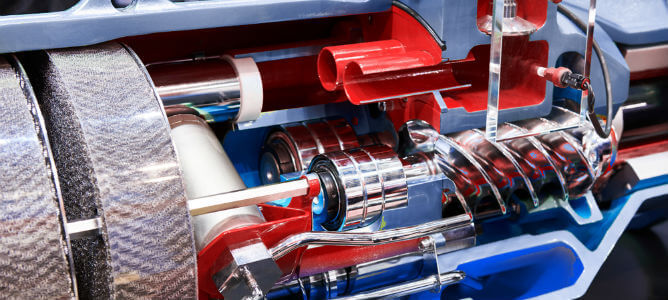
Instead of an up-and-down piston movement, a rotary screw air compressor relies on a continuous, rotational mechanism. These systems utilize two interlocking, helical male and female rotors housed within a stator frame, commonly called the airend. As the screws rotate at high speeds, the space between their interlocking grooves decreases, continuously compressing the trapped incoming air and moving it toward the discharge port.
Rotary screw systems are engineered in both oil-flooded (where oil seals the clearances and cools the air) and oil-free configurations for sensitive, contaminant-free processes.

Duty Cycle and Operational Patterns
Duty cycle dictates performance when comparing these commercial air compressor outputs.
- Reciprocating Duty Cycle (~20-50%): Piston compressors generate friction and intense thermal loads. They require intermittent operational pauses to cool down. If forced to run continuously at a 100% duty cycle, a reciprocating compressor rapidly overheats, leading to component degradation or system failure.
- Rotary Screw Duty Cycle (100%): Rotary screw compressors are engineered for continuous, uninterrupted operation. They feature an integrated fluid cooling system that regulates operational temperatures, allowing them to deliver constant high pressure air 24/7 without power or performance degradation.
Energy Efficiency Differences
Energy consumption varies drastically based on operational loads. Reciprocating compressors run efficiently in intermittent applications because they stop drawing power when demand drops. However, when forced into constant operation, frequent start/stop cycling causes voltage spikes, motor wear, and thermal stress.
Rotary screw compressors operate efficiently under continuous, heavy loads. Many industrial rotary models utilize variable speed drives (VSD) or load/unload controls to match air production exactly to real time demand, reducing facility electrical bills during extended production runs.
Noise Levels & Operating Environment
The mechanical action of each system affects the workspace environment. Reciprocating units produce substantial vibration and higher decibel levels due to the physical impact of the pistons and valves. This often necessitates separate compressor rooms or dedicated sound enclosures to meet workplace safety standards.
Rotary screw systems operate smoothly with minimal vibration, producing a much quieter sound profile suitable for indoor installations near active work areas.
Maintenance and Air Quality Profile
Both technologies require strict preventative maintenance schedules, though the wear items differ:
- Reciprocating Maintenance: Focuses on replacing mechanical wear items like piston rings, valves, belts, and crankcase lubricants. High duty usage accelerates this component wear and requires regular air compressor troubleshooting to prevent pressure losses.
- Rotary Screw Maintenance: Centers on fluid filters, air/oil separators, and airend inspections. While service intervals occur less frequently, airend rebuilds require specialized technical support.
Downstream air quality also depends on the compressor selection. Rotary units often feature integrated air dryers to combat moisture carryover, ensuring a low pressure dew point to prevent pipeline corrosion or control valve freezing.
Compressor Selection by Industrial Application
The choice between rotary screw vs. reciprocating air compressors depends on your industry classification and continuous cubic feet per minute (CFM) requirements.
| Application Environment | Preferred Technology | Operational Reason |
| Automotive Repair & Smaller Shops | Reciprocating | Intermittent tool usage, lower CFM requirements |
| Pipeline Pressure Testing | Reciprocating | Demands extreme, multistage PSI thresholds |
| Manufacturing & Assembly Lines | Rotary Screw | Continuous multishift demand, steady airflow |
| Oil & Gas Operations | Rotary Screw | Heavy duty, round-the-clock process air requirements |
| Chemical Processing Facilities | Rotary Screw | Requires high CFM and integrated air filtration |
Learn more: What Size Air Compressor Do I Need?
Choose a Reciprocating Compressor If:
- Your facility requires bursts of high-pressure compressed air rather than a continuous stream.
- You run specialized high pressure applications that demand pressures exceeding standard industrial thresholds.
- You operate a smaller shop or decentralized workstation with lower overall air volume needs.
Choose a Rotary Screw Compressor If:
- Your industrial operations cannot afford drops in pressure or downtime.
- You require massive, steady airflow volume to drive heavy pneumatic instrumentation, air tools, or process machinery.
- You want a low maintenance workhorse designed to minimize operational wear over thousands of running hours.
Contact NiGen for Expert Equipment Selection
NiGen provides industrial rotary screw air compressors, air dryer systems, and nitrogen generation equipment for oil and gas, pipeline, and industrial operations. We also offer temporary air compressor rental equipment and field support for demanding operations.
Get in touch with an experienced engineer today to get started with NiGen.